Tree Models
Tree commands train and use tree-based synthetic population models. They are most useful when we need generated rows with multivariate structure, or when households and people need to remain linked.
Concept
An IPF workflow reweights existing seed rows. A tree workflow learns patterns from training rows and generates new rows. In SynthPopCan, tree models can be:
flat person or household models from a training CSV;
linked household/person models from hierarchical microdata;
private working artifacts;
reviewed publishable-candidate artifacts after audit and release checks.
Treat models trained from restricted microdata as private unless they have been audited, reviewed, and packaged with provenance.
SynthPopCan currently uses transparent frequency-based and CART-style tree models. CART models are useful here because they expose conditional splits that can be audited more easily than many opaque generative models, but the audit step is still necessary.
What a Tree Model Is
A decision tree is a model made from branching questions. Each question splits the training rows into smaller groups. In a classification tree, the end of a branch is called a leaf, and the leaf contains the observed outcomes for records that reached that point.
For synthetic population work, a simplified person model might behave like this:
Is tenure owner?
├─ yes: use the age/sex distribution observed among owner households
└─ no:  use the age/sex distribution observed among non-owner households
A deeper tree might also split by province, household size, or age group. That extra detail can preserve useful structure, but it also reduces the number of training rows behind each branch. A model that splits too finely may look sophisticated while relying on only a handful of examples.
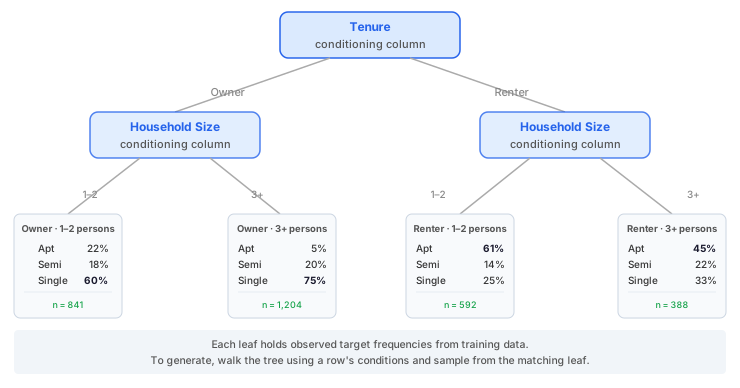
A trained tree for dwelling type conditioned on tenure and household size. Each leaf contains the observed target distribution for records that reached that branch. Generation draws from that distribution — it does not predict a single outcome, it samples one plausible outcome given the conditioning path.
SynthPopCan has two tree-family model types:
conditional-frequency: groups rows by the conditioning columns and samples from the observed target outcomes in each group. This is transparent and straightforward to audit, but sparse groups can be fragile.cart: trains a CART-style decision tree using scikit-learn. This can merge or split patterns more flexibly than exact frequency groups, but it still needs support, purity, and validation checks.
The scikit-learn decision-tree guide explains CART-style decision trees as models that split records by feature values to predict a target class. In SynthPopCan, the point is not prediction for its own sake. The point is to generate plausible categorical rows while preserving enough structure to support interpretation and audit.
What a Forest Model Is
A forest model, usually called a random forest, combines many decision trees. Each tree is trained on a different sample of rows or a different subset of columns, and the forest combines their results. In predictive modelling this can reduce the instability of one tree.
SynthPopCan does not currently train forest models. That is deliberate. A forest can be useful, but it is harder to explain to a humanities or digital-humanities reader because there is no single branch or leaf to inspect. For this project, the first priority is a model artifact that can be audited, packaged with provenance, and discussed plainly: what columns conditioned generation, how much support each group or leaf had, and whether any group looked too revealing.
If forest-style models are added later, they should come with stronger diagnostics, clear variable-importance reporting, and release checks that do not depend on reading one tree by eye.
What Makes a Tree Model Bad
A bad tree model is not just a model that fails to run. It is a model that generates rows that are misleading, unstable, or unsafe to share. Common problems include:
Too little support: a group or leaf is based on too few training records. Generated rows then depend on accidents of the sample rather than a stable pattern.
Overly pure groups: one outcome dominates a small group. This can signal memorization, especially when the conditioning columns are detailed.
Overfitting: the model follows the training rows too closely and loses the broader structure the synthetic population is supposed to represent.
Underfitting: the model is too coarse and washes out important relationships, such as household size by tenure or age structure by geography.
Target leakage: identifier-like columns, geography codes at too fine a level, or derived columns that already encode the answer make generation look accurate for the wrong reason.
Wrong population universe: training rows and intended output describe different populations, years, geographies, or inclusion rules.
Bad column roles: a target column is accidentally also used as a conditioning column, or a household-level attribute is treated as if it varied by person.
Sparse geography: splitting by a small region can produce weak support even if the national training file is large.
Broken linkage: a person model may generate people whose attributes do not match the household rows they are linked to, or household sizes may not match the generated number of people.
Missing provenance: without source notes, commands, random seeds, and validation reports, readers cannot tell what choices shaped the output.
These are methodological issues, not just software errors. Gargiulo and co-authors emphasize the importance of household structure in synthetic population generation, and privacy-preserving data-publishing surveys describe the recurring tradeoff between utility and disclosure risk. SynthPopCan’s audit commands are meant to make those issues visible before a model is treated as usable.
Reading Support and Purity
tree audit-model reports support and purity because they are practical warning
signals.
Support is the number or weighted count of training rows behind a group or leaf. Low support means the model has little evidence for that branch. A support value of 3 may be acceptable in a private experiment, but it is a poor basis for a shareable model.
Purity is the share of the dominant outcome in a group or leaf. A leaf where 98% of records have the same outcome is not automatically wrong. But if that leaf is also small, the model may be close to revealing a rare pattern from the training data.
Use these measures together:
low support and high purity is the strongest warning;
low support and mixed outcomes is unstable;
high support and high purity may describe a real common pattern;
high support and mixed outcomes is usually safer but may generate noisy rows.
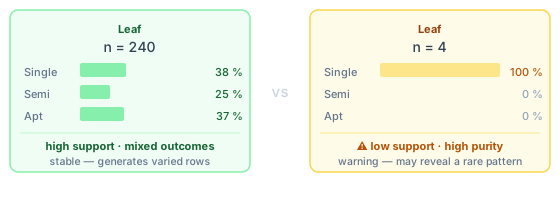
The same dwelling-type leaf in two very different states. High support with mixed outcomes (left) produces stable, varied generated rows. Low support with high purity (right) is the strongest audit warning: the model has almost no evidence for this branch, and one dominant outcome may reflect a handful of real records rather than a genuine pattern.
The default audit thresholds are conservative starting points, not universal rules. Choose stricter thresholds for public sharing, sensitive columns, or small geographies.
When a Tree Model Is Methodologically Weak
A tree model can pass basic software checks and still be weak for research. The most common problem is confusing a model that can generate rows with a model that supports the intended interpretation.
Watch for these patterns:
Predictive-looking output without a prediction question. Tree models can sound like predictive models, but SynthPopCan usually uses them to preserve categorical structure for synthetic generation. Do not interpret a split as a causal claim.
Too many conditioning columns. Every extra conditioning column can make groups smaller. A model conditioned on province, tenure, household size, age, sex, language, and income may be less stable than a simpler model.
Important relationships left out. A model that omits household size, tenure, or geography may generate rows that look plausible one column at a time but fail as households or communities.
Rare categories treated as ordinary categories. Sparse identity, language, migration, or geography categories may need aggregation or private handling rather than direct modelling.
Training data treated as neutral. The model learns from the training sample. If the source data has exclusions, survey design effects, coding choices, or historical bias, those choices shape the generated rows.
Release checks treated as ethics review.
tree audit-modelcan flag support, purity, raw-row metadata, and source identifiers. It cannot decide whether a generated population should be used for a sensitive interpretive claim.Model artifacts treated as harmless. A trained model is not automatically safe just because it is JSON rather than a CSV of source records. Splits, leaf counts, class summaries, encoders, and package metadata can still reveal rare paths or small subgroups.
Validation against the training view only. A tree-output validation report can compare generated rows to the training distribution. It does not prove the model matches an external population unless external controls are also used.
Linked rows validated only mechanically. Household/person linkage can be internally consistent while still sociologically implausible if the household and person models were trained with poor column choices.
Additional issues to consider before trusting a tree model:
Instability: a single decision tree can change a lot when the training rows, random seed, or selected columns change. Forests reduce some instability by averaging many trees, but they also make the model harder to inspect.
High-cardinality columns: postal codes, small geographies, detailed occupations, or many-category identity variables can create tiny branches and disclosure risk.
Class imbalance: rare outcomes may be ignored, exaggerated, or copied too directly, depending on the model and thresholds.
Out-of-domain conditions: asking a model to generate for a condition it barely saw, or never saw, can force fallback behaviour that looks valid in a CSV but has weak evidence.
Missing values are information: blank, unknown, not applicable, and refused responses are not interchangeable. Treating them all as ordinary categories can distort the generated population.
Survey weights shape training: if training rows have weights, the model is learning a weighted view of the source. If weights are ignored, common and rare groups may be misrepresented.
Unpruned trees memorize too much: default tree settings can grow many small leaves. Use deliberate leaf-size, depth, category-coarsening, and pruning choices for any model that might later be packaged.
Donor-style generation can leak: methods that draw directly from observed records inside a terminal node need special caution. If a leaf contains only a few donors, synthetic rows may be too close to source rows.
Column encoding changes meaning: collapsed categories, derived variables, and text labels are modelling decisions. A generated value is only as clear as the category system behind it.
Transfer is not automatic: a model trained on one geography, period, or population may not transfer to another. This is especially important when using one region to generate another because local structure matters.
Randomness affects interpretation: generated rows depend on random seeds. If a conclusion changes when the seed changes, the model is too unstable for that claim.
External validity is separate: matching the training distribution does not prove the generated population matches public controls or the historical world being studied.
Model Release And Disclosure Risk
SynthPopCan separates private working models from publishable-candidate models because trained models can carry disclosure risk. A safe-looking artifact can still contain or imply sensitive information through very small leaves, geography-specific paths, rare target values, source identifiers, bootstrap indices, donor lists, or raw-row fragments.
For linked household/person models, the risk is higher than for a flat person table. A household composition can be distinctive even when each field is ordinary on its own. Audit linked models as household signatures: household attributes plus the ordered or summarized composition of generated people.
Practical release rules:
keep restricted-source models private by default;
inspect the actual serialized artifact, not only the training options;
require non-trivial support in every group or leaf;
reject source rows, row IDs, household IDs, bootstrap indices, and donor lists in publishable artifacts;
use model cards or release manifests to state intended use, out-of-scope use, source description, parameters, validation results, limitations, and caveats;
do not claim anonymity or legal privacy safety merely because
prepare-model-releasesucceeded.
Good tree modelling is usually iterative. Start with fewer columns, inspect the training view, generate a small sample, validate distributions and linkage, then add detail only when the support remains adequate and the extra detail matters for the research question.
Practical Signs to Step Back
Pause and reconsider the model design when:
the audit report shows many low-support groups or leaves;
generated rows repeat the same combinations too often;
generated rows contain combinations that subject-matter readers find implausible;
small changes to the random seed noticeably change the story;
a small geography needs much stricter thresholds than the model can satisfy;
the model has to include sensitive or identifier-like columns to produce plausible output;
the model behaves differently after a harmless-looking change to the seed, training sample, or random seed;
the model depends on a very detailed category system that readers will not be able to interpret;
the generated output passes internal validation but fails against an external table or domain expectation;
the release narrative depends on “the tool passed” rather than on source, modelling, and validation evidence.
In those cases, the next step is usually not a bigger model. It is often a clearer research question, broader categories, a larger geography, fewer target columns, or a decision to keep the artifact private.
Getting Started: Linked Household and Person Models
Column choice is a research decision, not a technical default. Before training, ask the adapter to suggest which columns are safe and coherent for each record level. The suggestions are a starting point — review them before accepting, and consider whether the number of conditioning columns is appropriate for the geography’s row count:
synthpopcan microdata suggest-tree-columns \
  tests/fixtures/workflows/linked_tree/hierarchical.csv \
  --input-format statcan-2016-hierarchical
Train the linked household and person models. --suggested-blocks uses the
adapter’s default suggestion blocks (household_core and person_demographics).
For a broader model with all supported blocks, use --household-block all --person-block all; those still exclude identifiers, weights, and columns that
vary within a household on the person side:
synthpopcan tree train-linked \
  tests/fixtures/workflows/linked_tree/hierarchical.csv \
  --input-format statcan-2016-hierarchical \
  --suggested-blocks \
  --household-model-out household-model.json \
  --person-model-out person-model.json \
  --manifest-out linked-training.manifest.json \
  --random-seed 7
Generate a small linked sample to inspect before auditing. A small run (100–500 households) is enough to check that the linkage structure is correct and the output looks plausible:
synthpopcan tree generate-linked \
  --household-model household-model.json \
  --person-model person-model.json \
  --households 100 \
  --households-out synthetic-households.csv \
  --persons-out synthetic-persons.csv \
  --manifest-out synthetic-linked.manifest.json \
  --random-seed 13
Validate the linkage — checks that household and person IDs are consistent, that household sizes match the generated person counts, and that no structural errors exist before treating the output as usable:
synthpopcan validate linked-output \
  --households synthetic-households.csv \
  --persons synthetic-persons.csv
Audit both models before considering release or reuse. The audit checks every group or leaf for support and purity against the chosen thresholds, and checks whether the artifact metadata indicates raw rows or source identifiers may be present. A model that passes the audit at these thresholds is a candidate for release preparation; one that does not should be treated as a private working artifact:
synthpopcan tree audit-model household-model.json \
  --min-support 50 \
  --max-purity 0.95

synthpopcan tree audit-model person-model.json \
  --min-support 50 \
  --max-purity 0.95
If the audit reports low support or high purity, the usual responses are: reduce the number of conditioning columns, combine fine categories, use a larger geography, or accept that this model stays private.
Subcommands
tree train
Trains one flat model from a CSV training sample.
synthpopcan tree train person-training.csv \
  --level person \
  --target-columns AGEGRP,SEX \
  --conditioning-columns TENUR,household_size \
  --weight-column WEIGHT \
  --out person-model.json
Options include --method conditional-frequency|cart, --random-seed,
--min-support, --min-samples-leaf, and --max-depth.
Use conditional-frequency when we want a direct, inspectable relationship
between conditioning columns and generated target outcomes. Use cart when exact
conditioning groups are too sparse and a decision tree can pool similar cases.
Neither method removes the need for validation.
tree train-linked
Trains household and person models from mixed hierarchical microdata.
synthpopcan tree train-linked hierarchical.csv \
  --suggested-blocks \
  --geo-column PR \
  --geo-value 24 \
  --target-profile reduced \
  --household-model-out household-pr24.json \
  --person-model-out person-pr24.json \
  --manifest-out linked-training-pr24.manifest.json
The linked workflow is useful when household and person rows need to agree with each other. The household model generates household attributes first. The person model then generates the people inside each household using shared conditioning columns, such as household size or tenure.
Bad linked models often come from mixing levels. For example, a person-level attribute should not be used as if it were constant for the household unless the training export has explicitly derived a household-level summary.
tree generate
Generates flat rows from a single model file. Use this for non-linked (flat person or household) models. For generating from a reviewed package, see Generate From a Model Package.
synthpopcan tree generate person-model.json \
  --rows 100 \
  --condition PR=24 \
  --out synthetic-persons.csv \
  --manifest-out synthetic-persons.manifest.json
tree generate-linked
Generates households and persons from two separate model JSON files rather than a packaged artifact. Use this when working with local model files that have not yet been packaged. For generating from a reviewed package, see Generate From a Model Package.
synthpopcan tree generate-linked \
  --household-model household-model.json \
  --person-model person-model.json \
  --households 1000 \
  --condition PR=24 \
  --households-out synthetic-households.csv \
  --persons-out synthetic-persons.csv
tree audit-model
Audits a model artifact for release-oriented risk checks.
synthpopcan tree audit-model household-model.json \
  --min-support 50 \
  --max-purity 0.95
Important options:
--min-support: minimum acceptable support for each group or leaf.--max-purity: warning threshold for dominant-outcome purity.
The audit also checks whether model metadata says raw rows or source identifiers may be present. A model with those flags should not be treated as a release candidate.
tree package-model
Packages a single flat tree model only after audit-model passes without
warnings.
synthpopcan tree package-model household-model.json \
  --out household-model-package.json \
  --min-support 50 \
  --max-purity 0.95
This command is intentionally stricter than audit-model: an audit report can
be useful even when it contains warnings, but package-model refuses to write a
package until the audit is clean. For linked household/person work, use
prepare-model-release, release-readiness, and package-linked-models
instead.
tree prepare-model-release
Applies release checks to a private working model and writes a
publishable-candidate copy. The checks are the same as audit-model — support,
purity, raw-row metadata — but the command refuses to write output if any check
fails. The --review-note is embedded in the artifact and should describe what
was reviewed and by whom. Run this separately for the household and person models
before release-readiness or package-linked-models.
synthpopcan tree prepare-model-release household-model.json \
  --out household-model-publishable.json \
  --manifest-out household-model-release.manifest.json \
  --min-support 50 \
  --max-purity 0.95 \
  --review-note "Reviewed for minimum support, purity, and raw-row metadata."
tree release-readiness
Checks whether a pair of publishable-candidate models and their training
manifest are jointly ready for linked packaging. Reports support and purity
across both models, checks that the household-size column is present and
consistent, and confirms both models have been through prepare-model-release.
Run this before package-linked-models — the packaging step applies the same
checks and will also refuse on failure, but release-readiness gives a readable
summary report without committing to writing the package.
synthpopcan tree release-readiness \
  --household-model household-model-publishable.json \
  --person-model person-model-publishable.json \
  --training-manifest linked-training.manifest.json \
  --household-size-column household_size \
  --min-support 50 \
  --max-purity 0.95
tree package-linked-models
Bundles reviewed household and person models with their training manifest,
source provenance, release manifests, and review notes into a single
distributable package file. The package is the artifact that
tree generate-from-package consumes; it embeds enough metadata for downstream
readers to understand what source data was used, what audit thresholds were
applied, and what the reviewer attested.
--source-provenance is required. It must be a JSON file with the schema
synthpopcan-source-provenance-v1, recording the source title, provider,
access class, citation, and redistribution terms. Do not omit it — the package
is the public face of a workflow that used restricted data, and provenance is
part of the research record.
synthpopcan tree package-linked-models \
  --household-model household-model-publishable.json \
  --person-model person-model-publishable.json \
  --training-manifest linked-training.manifest.json \
  --source-provenance source-provenance.json \
  --household-release-manifest household-release-manifest.json \
  --person-release-manifest person-release-manifest.json \
  --review-note "Reviewed for release after readiness report." \
  --min-support 50 \
  --max-purity 0.95 \
  --out linked-model-package.json
tree list-packages
Lists model packages known to SynthPopCan. The tiny demo package is bundled. Large published packages are listed as downloadable until fetched into the local model cache.
synthpopcan tree list-packages
synthpopcan tree list-packages --format json
synthpopcan models list
synthpopcan models fetch montreal-cma-2016-all-fields
Use the package ID with tree inspect-package or
tree generate-from-package.
tree generate-from-package
Generates linked rows directly from a reviewed package.
synthpopcan tree generate-from-package linked-model-package.json \
  --households 1000 \
  --condition PR=24 \
  --households-out synthetic-households.csv \
  --persons-out synthetic-persons.csv
The first argument can be either a local package JSON path or a model ID from
models list. Large published models must be fetched first with
synthpopcan models fetch MODEL_ID.
This command streams linked household and person CSVs as it generates them, so large outputs do not need to fit in memory before writing. The generation manifest records both the requested household count and the actual generated person count.
Large package generation is optimized internally by reusing repeated condition lookups and precomputed sampling weights. CSV remains the normal user-facing output; alternative columnar formats, if added later, should be treated as advanced or internal performance options.
Generated rows preserve the source model’s raw codes. For 2016 PUMF-derived
packages, values such as 99999999, 9999, 99, and 9 are usually
Statistics Canada special codes such as not applicable, not available, or valid
skip, depending on the column. Do not treat these as ordinary numeric values
without decoding the relevant field metadata.
Example: Broad Montréal CMA Linked Model
This example shows the full CLI sequence for a local 2016 hierarchical PUMF
workflow. It uses Montréal CMA (CMA=462), combines all currently supported
household and person suggestion blocks, checks release-readiness, prepares
publishable-candidate copies, packages the linked model, and generates a large
linked synthetic population.
The source microdata path below is intentionally under data/raw and the
outputs are under data/private; neither should be committed to the repository.
mkdir -p data/private/benchmarks/tree-release-2016-cma462-all-fields
Train the broad linked household/person model:
synthpopcan tree train-linked \
  "data/raw/statcan/2016-census/PUMF Census 2016/pumf-98M0002-E-2016-hierarchical/pumf-98M0002-E-2016-hierarchical_F1.csv" \
  --suggested-blocks \
  --household-block all \
  --person-block all \
  --geo-column CMA \
  --geo-value 462 \
  --target-profile full \
  --random-seed 7 \
  --household-model-out data/private/benchmarks/tree-release-2016-cma462-all-fields/household-model.json \
  --person-model-out data/private/benchmarks/tree-release-2016-cma462-all-fields/person-model.json \
  --manifest-out data/private/benchmarks/tree-release-2016-cma462-all-fields/linked-training-manifest.json
Check whether the private working models are eligible for release preparation:
synthpopcan tree release-readiness \
  --household-model data/private/benchmarks/tree-release-2016-cma462-all-fields/household-model.json \
  --person-model data/private/benchmarks/tree-release-2016-cma462-all-fields/person-model.json \
  --training-manifest data/private/benchmarks/tree-release-2016-cma462-all-fields/linked-training-manifest.json \
  --household-size-column household_size \
  --min-support 50 \
  --max-purity 0.95
Prepare reviewed publishable-candidate copies:
synthpopcan tree prepare-model-release \
  data/private/benchmarks/tree-release-2016-cma462-all-fields/household-model.json \
  --out data/private/benchmarks/tree-release-2016-cma462-all-fields/household-model-publishable.json \
  --manifest-out data/private/benchmarks/tree-release-2016-cma462-all-fields/household-release-manifest.json \
  --min-support 50 \
  --max-purity 0.95 \
  --review-note "Montreal CMA 462 all-household and all-person-block household model reviewed with SynthPopCan release checks."

synthpopcan tree prepare-model-release \
  data/private/benchmarks/tree-release-2016-cma462-all-fields/person-model.json \
  --out data/private/benchmarks/tree-release-2016-cma462-all-fields/person-model-publishable.json \
  --manifest-out data/private/benchmarks/tree-release-2016-cma462-all-fields/person-release-manifest.json \
  --min-support 50 \
  --max-purity 0.95 \
  --review-note "Montreal CMA 462 all-household and all-person-block person model reviewed with SynthPopCan release checks."
Create a small source-provenance JSON file before packaging. The exact metadata should match the source access terms and citation used by the project:
{
  "schema_version": "synthpopcan-source-provenance-v1",
  "title": "2016 Census Hierarchical Public Use Microdata File",
  "provider": "Statistics Canada",
  "access_class": "local restricted/source-controlled data root",
  "citation": "Statistics Canada, 2016 Census Hierarchical Public Use Microdata File.",
  "redistribution_note": "Do not redistribute source microdata. Package contains model artifacts only.",
  "local_path": "data/raw/statcan/2016-census/PUMF Census 2016/pumf-98M0002-E-2016-hierarchical/pumf-98M0002-E-2016-hierarchical_F1.csv"
}
Package the linked model:
synthpopcan tree package-linked-models \
  --household-model data/private/benchmarks/tree-release-2016-cma462-all-fields/household-model-publishable.json \
  --person-model data/private/benchmarks/tree-release-2016-cma462-all-fields/person-model-publishable.json \
  --training-manifest data/private/benchmarks/tree-release-2016-cma462-all-fields/linked-training-manifest.json \
  --source-provenance data/private/benchmarks/tree-release-2016-cma462-all-fields/source-provenance.json \
  --household-release-manifest data/private/benchmarks/tree-release-2016-cma462-all-fields/household-release-manifest.json \
  --person-release-manifest data/private/benchmarks/tree-release-2016-cma462-all-fields/person-release-manifest.json \
  --review-note "Montreal CMA 462 all-household and all-person-block linked package reviewed by SynthPopCan release-readiness checks." \
  --out data/private/benchmarks/tree-release-2016-cma462-all-fields/linked-model-package.json \
  --household-size-column household_size \
  --min-support 50 \
  --max-purity 0.95
Generate the linked synthetic population:
synthpopcan models list
synthpopcan models fetch montreal-cma-2016-all-fields
synthpopcan tree inspect-package montreal-cma-2016-all-fields
synthpopcan tree generate-from-package \
  montreal-cma-2016-all-fields \
  --households 1830000 \
  --households-out data/private/benchmarks/tree-release-2016-cma462-all-fields/synthetic-households.csv \
  --persons-out data/private/benchmarks/tree-release-2016-cma462-all-fields/synthetic-persons.csv \
  --manifest-out data/private/benchmarks/tree-release-2016-cma462-all-fields/synthetic-linked-manifest.json \
  --random-seed 7
The household count is controlled directly by --households. The person count
is generated from the model’s household-size distribution, so it will usually
not match a separate target exactly. In one local Montréal CMA run, requesting
1,830,000 households produced 4,238,633 person rows.
The Montréal package is a published model package. It is listed by the CLI and
web app, but the large JSON is downloaded into a local cache only after
synthpopcan models fetch montreal-cma-2016-all-fields.
Example: Quebec Province Linked Model With Python
The advanced library documentation includes a maintained Python script for the
same release pattern applied to Quebec (PR=24). Use it when we want a
reproducible library workflow rather than a long command-line transcript:
uv run python scripts/build_quebec_model_package.py
uv run python scripts/build_quebec_model_package.py --generate
The first command trains, audits, releases, and prepares the reviewed
quebec-2016-all-fields package for release-asset upload. The optional
--generate run writes the large local household/person CSV outputs under
data/private/benchmarks/.
See Advanced Library Use for
the script and notes about what belongs in the public repo versus release
assets.
tree inspect-package
Prints a package summary without dumping embedded model payloads.
synthpopcan tree inspect-package linked-model-package.json
synthpopcan tree inspect-package linked-model-package.json --format json
synthpopcan tree inspect-package montreal-cma-2016-all-fields
The argument can be a local package JSON path or a packaged model ID from
models list. Downloadable IDs must be fetched first with
synthpopcan models fetch MODEL_ID.
Troubleshooting
Audit reports low support: reduce the number of conditioning columns, use a
larger geography, combine categories, or switch from an exact
conditional-frequency model to a CART model with sensible leaf-size settings.
Audit reports high purity: inspect the conditioning columns. Remove identifier-like columns, overly detailed geography, or columns that effectively encode the target.
Generated rows look too repetitive: the model may be underfit, or the conditioning values may route generation into one narrow group. Add appropriate conditioning columns only if the training data has enough support.
Generated rows look too detailed or too realistic: the model may be
overfit. Increase --min-support, increase --min-samples-leaf, reduce
--max-depth, combine categories, or keep the model private.
Model is very large: review target columns and consider reduced or minimal profiles. Large models can signal overly detailed categories.
Linked validation fails: check household ID columns and household-size fields before interpreting the generated data.
Package refuses to write: inspect audit warnings, source provenance, release manifests, and review notes.
Further Reading
scikit-learn, Decision Trees user guide, for background on CART-style models.
Floriana Gargiulo and co-authors, An iterative approach for generating statistically realistic populations of households, for why household structure matters.
Stanislav Borysov, Jeppe Rich, and Francisco Pereira, Scalable Population Synthesis with Deep Generative Modeling, for a contrasting generative-model approach.
Tania Carvalho, Nuno Moniz, Pedro Faria, and Luis Antunes, Survey on Privacy-Preserving Techniques for Data Publishing, for the disclosure-control tradeoff between privacy protection and utility.