Field Primer
This page is a broad introduction to the field around SynthPopCan. It is meant to sit somewhere between a primer, a methods essay, and a research map. We can use the command sections without reading it first, but it explains why the commands are shaped the way they are.
Why Synthetic Populations Exist
A synthetic population is a modelled population made of records that look like people, households, families, dwellings, or other units. The records are not supposed to be the original people. They are generated so that selected features match a target population closely enough for a particular use.
This idea is useful because many research questions need row-shaped data:
a simulation needs people in households;
a teaching example needs realistic demographic variation;
a digital-history project needs plausible household structure;
a policy model needs units linked to geography;
a software system needs test records that are not real people;
a privacy-conscious workflow needs public outputs without distributing restricted microdata.
The danger is that a synthetic population looks more concrete than it is. A CSV with one row per person can feel like evidence. It is better to read it as a model: a disciplined argument about what a population could look like, given source tables, microdata, category mappings, assumptions, random seeds, and validation choices.
A Short Lineage
Synthetic population work has roots in spatial microsimulation, transportation planning, epidemiology, statistical disclosure control, and agent-based simulation. Older IPF-based approaches often start with a microdata sample and reweight it to match area-level margins. Pritchard and Miller’s population synthesis work is an important local reference for SynthPopCan because it treats many categorical attributes sparsely and keeps household/person realization as a separate stage after fitting.
More recent systems and papers broaden the field:
PopulationSim provides a production-grade Python reference for expanding household/person seed samples to match controls across geographies.
synthpopshows how tree-based models can synthesize tabular microdata while raising utility and disclosure-risk questions.Deep and hybrid population-synthesis work, such as Borysov, Rich, and Pereira and Kim and Bansal, explores generative models for household/person relationships, geographic transfer, and structural-zero recovery.
Differential privacy work offers a formal way to reason about privacy loss, but it changes the modelling problem: one often measures noisy aggregates and synthesizes from those measurements rather than releasing raw trained models.
SynthPopCan’s first design deliberately stays closer to explainable, auditable methods: IPF, conditional-frequency models, CART-style tree models (Classification And Regression Trees — decision trees that recursively split training data until each branch is relatively homogeneous), constrained generation, validation, and provenance.
What Makes Canadian Data Awkward
The Canadian case is not just “take a generic synthetic-population package and point it at Statistics Canada.” Several details matter.
Statistics Canada aggregate tables are not all shaped as ready-to-fit controls. The Census Profile is a long table of geographies and characteristics. WDS tables have their own dimensions, labels, value columns, metadata, and download formats. A table must be inspected and normalized before it becomes a control table.
PUMF microdata also has structure. The 2016 hierarchical PUMF is especially important because it carries household, economic-family, census-family, and person identifiers. That makes it useful for household/person modelling, but it also means that a person row is not the whole story. Household structure, family relationships, and linked person composition are part of the model.
Finally, Canadian public tables may include rounding, suppression, sampling notes, quality flags, different universes, and different geography levels. These are not annoyances around the edge. They shape what a synthetic population can honestly claim.
Two Families of Methods
SynthPopCan currently separates two method families.
IPF and Calibration
Iterative proportional fitting, often called IPF or raking, adjusts weights on a seed table so that selected margins match target controls. The seed rows already contain the variables. IPF changes how much each row counts.
This is powerful when the seed has the right columns and enough category coverage. It is weak when the controls ask for things the seed cannot represent. IPF cannot invent a missing variable, create a missing joint category, or fix controls that describe incompatible populations.
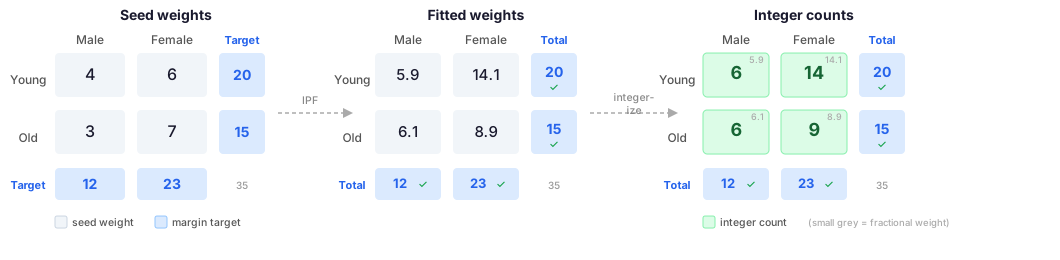
IPF adjusts the seed weights (left) until each row sum and column sum matches the corresponding margin target (blue). The seed’s proportional structure is preserved; only the scale of each cell changes. The final step converts fractional fitted weights into integer counts — a rounding decision that is separate from the fitting itself, but one that must preserve the margin totals.
The most important conceptual distinction is between fitting and realization. A weighted table is one object. An integer synthetic population is another. When fractional weights are expanded into rows, a rounding or sampling decision has been made. Lovelace and Ballas discuss this problem directly in the spatial microsimulation context.
Tree-Based and Conditional Generation
Tree-based generation starts from training rows rather than a control table alone. A decision tree asks branching questions about conditioning columns and uses the observed outcomes in a group or leaf to generate target values. A conditional-frequency model is even more direct: group by the conditioning columns and sample target outcomes from that group.
Tree models are attractive because they can preserve richer combinations of variables than simple margins. They can also support linked household/person generation: generate household attributes first, then generate people inside those households using shared conditions such as household size, tenure, or geography.
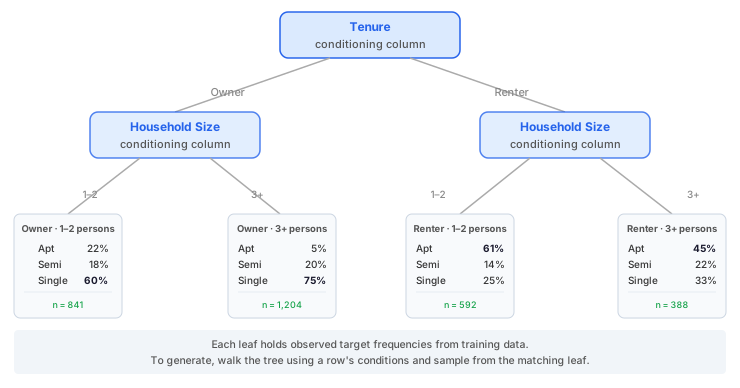
A conditional-frequency tree splits training rows by conditioning columns (here Tenure then Household Size). Each leaf records the observed distribution of the target variable (dwelling type). To generate a new record, walk the tree using the row’s known conditions and sample from the matching leaf.
Tree models do not remove the need for controls. A model can generate plausible records and still fail local margins. For SynthPopCan, tree output is best read as candidate records that may later need calibration, constrained sampling, or repair against public controls.
Why Forests Are Not the First Tool Here
A forest combines many trees, often improving predictive stability. Random forests and gradient-boosted trees can be attractive when a single CART tree is too unstable.
The tradeoff is interpretability. A single tree has leaves, supports, dominant outcomes, and paths that can be inspected. A forest has many trees, aggregate votes, and more complex internal evidence. For humanities and digital-humanities readers, that difference matters. A forest may predict better while being harder to explain, audit, or package as a public research artifact.
This does not mean forests are wrong. It means they should arrive with stronger diagnostics: variable-importance reporting, out-of-domain checks, stability tests, membership-risk thinking, and clear release rules.
Structural Zeros and Sampling Zeros
One subtle idea appears again and again in synthetic-population work: structural zeros are not the same as sampling zeros.
A structural zero is a combination that should not occur. A sampling zero is a combination that could occur but was not observed in the seed or training data. For example, “household size equals zero” is structurally impossible. A rare age-language-tenure combination might be a sampling zero in a small geography.
IPF and tree models can both stumble here:
IPF has no row to weight when a target cell is absent from the seed.
A tree model may treat a missing combination as impossible because the training data never observed it.
Deep generative models may recover some sampling-zero diversity, but they add their own interpretability and validation burdens.
For humanities work, this is not just a technical issue. It is a question about what kind of absence the model is encoding.
Privacy, Disclosure, and Model Artifacts
Synthetic data is not automatically private. A generated table can leak through rare combinations, memorized rows, or highly distinctive linked households. A trained model can also leak, even if it does not contain a raw CSV.
Tree models deserve special caution. A serialized tree can expose split features, thresholds, leaf counts, class summaries, and rare paths. If a model uses donor-style generation from terminal nodes, a small leaf can become too close to the source records. If a whole model is distributed, white-box attacks and membership-inference concerns become more relevant than they would be for a closed internal service.
Linked household/person outputs raise the bar further. A household can be distinctive because of the combination of dwelling attributes and person composition, even when no single person-level field looks rare. Release checks therefore need to consider household signatures, not just person rows one at a time.
SynthPopCan’s practical posture is conservative: working models stay private, publishable-candidate models require audit evidence and provenance, and no generated output should claim absolute anonymity. The detailed release rules and what each check covers are in Tree Models.
Evaluation Is Not One Number
A synthetic population can be evaluated in several different ways. No single metric is enough.
For IPF and calibrated outputs, check:
absolute and relative margin error;
worst controls and worst geographies;
inconsistent margin totals;
structural-zero and zero-cell diagnostics;
extreme weights and effective diversity;
integerization drift after expansion.
For tree-generated outputs, check:
distribution similarity to training views;
support and purity of groups or leaves;
sensitivity to random seeds;
rare generated combinations;
out-of-domain conditions;
household/person linkage;
external controls, when available.
For all outputs, keep provenance: input files, source URLs, access status, category mappings, commands, package version, random seeds, validation reports, and notes about unresolved limitations.
What Humanities Readers Can Bring
Humanities and digital-humanities readers often bring strengths that are central to this work: attention to categories, sources, interpretation, silences, provenance, and the politics of representation. Those are not secondary concerns. They are the work.
Synthetic populations make choices visible:
Which categories were preserved?
Which identities were collapsed?
Which geography became the unit of interpretation?
Which source table was treated as authoritative?
Which absences were interpreted as impossible?
Which relationships were validated, and which were left unmeasured?
The aim is not to hide those choices behind a technical interface. The aim is to make them explicit enough that readers can argue with them.
Reading Map
Start with the command pages when we need to run a workflow:
Which Workflow Should We Use? when we know the task but not the right surface;
IPF for margin-table calibration;
Tree Models for conditional and linked household/person generation;
Controls and Statistics Canada Sources for preparing public aggregate sources;
Validate for checking generated artifacts.
Return to this primer when we need to explain what the output means, and use Glossary when a census, modelling, or software term needs a compact definition.
Tool Reference Map
This section maps field concepts to the current SynthPopCan documentation surface. It is deliberately short; the command pages contain the actual commands, options, examples, and troubleshooting.
Source visibility: use Data to check local data layout and inspect source-file shape before deciding whether a file belongs in a workflow.
Public aggregate tables: use Statistics Canada Sources to find, explain, and fetch Statistics Canada sources. The interpretive question is whether the table’s dimensions, geography, year, and population universe fit the research question.
Control construction: use Controls when a source table needs to become a normalized margin or control CSV. This is where category mapping becomes explicit.
Seed and training rows: use Microdata when local microdata needs to become IPF seed rows or tree-training rows.
Calibration: use IPF for the check, fit, report, validate pattern. IPF changes row weights; it does not invent unsupported categories.
Conditional generation: use Tree Models for tree-model training, generation, linked household/person workflows, and model-release review.
Validation: use Validate to keep explicit evidence beside each generated artifact. Validation is evidence, not a certificate.
Further Reading
ActivitySim, PopulationSim documentation, for a production-grade population synthesis workflow using seed samples and controls.
Robin Lovelace and Dimitris Ballas, Truncate, replicate, sample, for integerizing spatial microsimulation weights.
Floriana Gargiulo, Sonia Ternes, Sylvie Huet, and Guillaume Deffuant, An iterative approach for generating statistically realistic populations of households.
The
synthpopproject, resources and package documentation, for tree-based synthetic microdata and disclosure-risk framing.scikit-learn, Decision Trees user guide, for CART-style decision trees.
Stanislav Borysov, Jeppe Rich, and Francisco Pereira, Scalable Population Synthesis with Deep Generative Modeling, for a contrasting deep generative approach.
Haewon Kim and Prateek Bansal, A Deep Generative Model for Feasible and Diverse Population Synthesis, for structural-zero and sampling-zero concerns in newer models.
Margaret Mitchell and co-authors, Model Cards for Model Reporting, for documenting intended use, limitations, and evaluation.
NIST, SP 800-226: Guidelines for Evaluating Differential Privacy Guarantees, for formal privacy-loss framing.